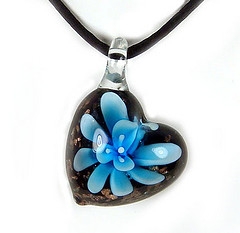
italian murano bead necklace

Thousand flowers all trapped in glass

Millefiori, say Italians. Thousand flowers, say English-speaking people. Words bring to mind cherry blossom festival in Japan, or fields of wild flowers on the hills of Tuscany. It is the name for one of the most beautiful techniques for glass making ever invented.

The ‘fiori’ or flowers are made of small beads of cut glass. The beads are cut from long rods of glass, forged from many strips of glass of different colors that are melted together. The rods are cut into small slices, or beads. The cross section of rods shows the interplay of colored glass, each different and unique. The beads were, and still are, used to make various objects, from pendants to elaborate paintings, where each bead was used like you would normally use dabs of paint, to create a larger picture. The effects ‘flowers’ create are mesmerizing, only limited by the imagination of its creators.

According to Carl Gable, who wrote an elaborate book on Venetian glass, millefiori glass making technique has been invented more that four thousand years ago in the Middle East, but most data places this invention at the hands of Phoenicians or Egyptians. There are some archeological finds of fragments of objects decorated with millefiori, showing extremely elaborate designs, in the tombs of Egyptian pharaohs. Romans continued playing with millefiori glass and spread the technique all over the world, from Europe to China. But, as it happened with so many such inventions, the secret of making millefiori was lost in time and abandoned, until one imaginative and patient glass maker from Murano rediscovered it in the early 16th century. He and his fellow glass makers went on to make millefiori what it is today: the most beautiful showcase of glass making that is coming from the Murano workshops.

There are many different ways Murano glassmakers play with colors, shapes, materials and patterns to make millefiori art objects. Millefiori beads can be fused with gold or silver leaf, mixed with precious or semi-precious stones, stretched to form rings, or, like in old times, used like dots of color to form scenes from nature, history or imagination. In the past, millefiori decorated pharaohs’ tombs in Egypt and Roman wine goblets. They are still made in Murano the same way they were made thousands of years ago, piece by piece, painstakingly putting together colored glass from hot furnaces of Murano to glass showcases of the world.

In the eyes of many customers all over the world, millefiori became the synonym with Murano glass making. Vivid colors, play of light in differently shaped objects, and particularly in jewelry pieces like pendants or beaded necklaces, bring Murano, Venice and Italy into ordinary homes on all continents. They are sufficiently affordable now to decorate many beautiful necks and ears of girls who were lucky to get such original gift, or to break the monotony of a work desk in many gray, boring offices in the shape of colorful millefiori paperweights or paper knives. There is nothing that brings colors, play of light and shade, history and magic of Venice like millefiori.

About the Author

<a href=”http://www.glassofvenice.com/millefiori-pendants-c-116.html”>Millefiori</a> | Murano Glass Jewelry and Accessories imported directly from Venice, Italy. For details visit http://www.glassofvenice.com

Share and Enjoy:
  • Print
  • Digg
  • Sphinn
  • del.icio.us
  • Facebook
  • Mixx
  • Google Bookmarks
  • Blogplay
  • Add to favorites
  • Blogosphere News
  • email
  • Fark
  • FriendFeed
  • LinkedIn
  • Linkter
  • MySpace
  • PDF
  • Ping.fm
  • Propeller
  • Reddit
  • RSS
  • Slashdot
  • StumbleUpon
  • Technorati
  • Tumblr
  • Twitter

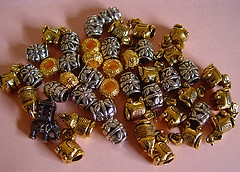
pandora bead making supplies

Gold Mining: How Do We Get Gold Out of the Ground

The precious metal of gold has fascinated humans for thousands of years. But how do we actually get it out of the ground? Let’s take a look at the most common ways to mine gold.

There are two main gold mining methods, one is called “placer” and the other is “vein” mining. And another type of mining is when gold is collected as a by-product in the mining of other metals.

Placer Mining

Placer mining is practiced when the metal is found in unconsolidated deposits of sand and gravel from which the gold can be easily separated because of its high density. The sand and gravel suspended in moving water. Much heavier metal sinks to bottom and is separated by hand.

The simplest method of placer mining is panning. Here the miner swirls the mixture in a pan rapidly enough to carry the water and most of the gravel and sand over the edge while the gold remains on bottom. This was the classic method used by the Forty-Niners during the California gold rush of 1849 and has been immortalized in story, art, and song.

A more efficient form of placer mining uses a sluice box, a U-shaped trough with a gentle slope and transverse bars firmly attached to the trough bottom.

The bars — extending from side to side — catch the heaviest particles and prevent them from washing down the slope.

Sand and gravel are placed in the high end, the gate to a water supply is opened, and the lighter material is washed through the sluice box and out the lower end. The materials are caught behind the bars and are gleaned to recover gold.

Another variation of placer mining is called hydraulic mining. A very strong stream of water is directed at natural sand and gravel banks washing away the lighter materials. The suspended materials treated as if they were in giant sluice box.

Currently the most important placer technique is dredging. A huge shovel of several cubic meters capacity lifts the unconsolidated sand and gravel from soil and mud and the placer process starts.

Vein Mining

Vein, or lode mining is the most important of gold recovery methods. Each ounce of gold recovered requires the processing of about 100,000 ounces of ore. Much gold is deposited in rock veins and this method accounts for more than half world’s total gold production. Gold in veins may be of microscopic particle size, in nuggets or sheets, or in gold compounds. The ore requires extensive extraction and refining.

One-third of all gold is produced as a by-product of copper, lead, and zinc production. Copper must be electrolytically refined to raise its purity from 99% to the more than 99.99% that is required for many industrial purposes.

In the refining process an anode of impure copper is electrolyzed in a bath in which the cathode is a very thin sheet of highly refined copper. This process

creates anode sludge which contains gold in quantities sufficient to make its recovery profitable. One-third of all gold is obtained from such by-products.

Silver and platinum are also recovered from the copper anode sludge in quantities large enough to more than pay for the total refining process.

Extraction, Refining and Uses of Gold

Ore from the gold mine is first crushed in rod or ball mills. This process reduces the ore to a powdery substance. The gold is then extracted by amalgamation with mercury or by placer procedures. Approx. 70% is recovered at this point.

The remainder is then dissolved in dilute solutions of sodium cyanide or calcium cyanide. The addition of metallic zinc to these solutions causes metallic gold to precipitate. This precipitate is refined by smelting and the purification is completed by electrolysis. The sludge produced in this process will also contain commercial quantities of silver, platinum, osmium, and other rare-earth metals.

Gold is one of the first two or three metals, along with copper and silver that was used by humans in these metals’ elemental states. Because of its poor chemical reactivity it was found uncombined and required no knowledge of refining. Gold was used in decorative arts before 9000 BC. And civilizations prized gold for its beauty.

A principal use of gold today is as a currency reserve. For centuries gold was used directly as currency along with silver. During the 19th century, gold assumed the role as the sole basis of the currencies of most nations. Paper money was directly convertible into gold.

World War I, however, disrupted the “gold-standard” system. The original gold standard was gradually abandoned. The United States stopped minting gold coinage in 1934 and the dollar eventually emerged as the principal unit of international monetary transactions.

Since the 1970s, gold has been bought and sold on the world market, with widely fluctuating prices. Today gold reserves maintain only a very indirect relationship with currency values. However, as gold has declined as a currency reserve, its use in industrial processes has risen. On top of this, its beauty and workability continue to give gold an important role in the world’s jewelry industry.

About the Author

Lewis Jewelers is proud to carry the full line of
Pandora Jewelry
. Pandora bracelets, Pandora charms and Pandora beads are only a part of the collection. For more information, Lewis Jewelers, 2000 West Stadium Blvd., Ann Arbor, Michigan, 48103, 877-88-LEWIS or visit the website.

Share and Enjoy:
  • Print
  • Digg
  • Sphinn
  • del.icio.us
  • Facebook
  • Mixx
  • Google Bookmarks
  • Blogplay
  • Add to favorites
  • Blogosphere News
  • email
  • Fark
  • FriendFeed
  • LinkedIn
  • Linkter
  • MySpace
  • PDF
  • Ping.fm
  • Propeller
  • Reddit
  • RSS
  • Slashdot
  • StumbleUpon
  • Technorati
  • Tumblr
  • Twitter

wholesale pandora silver charms

Share and Enjoy:
  • Print
  • Digg
  • Sphinn
  • del.icio.us
  • Facebook
  • Mixx
  • Google Bookmarks
  • Blogplay
  • Add to favorites
  • Blogosphere News
  • email
  • Fark
  • FriendFeed
  • LinkedIn
  • Linkter
  • MySpace
  • PDF
  • Ping.fm
  • Propeller
  • Reddit
  • RSS
  • Slashdot
  • StumbleUpon
  • Technorati
  • Tumblr
  • Twitter